1

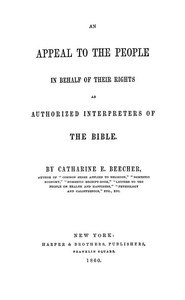
An Appeal to the People in Behalf of Their Rights as Authorized Interpreters of the Bible — Reading Notes
(0 User reviews)
654
Project Gutenberg
2018
Not confirmed
Bible -- Criticism, interpretation, etc.; Predestination; Grace (Theology); Religion -- Philosophy
Readers of public-domain and historical texts
Project Gutenberg digital edition
en
Edition facts
Words
111,854
Reading time
487 min
Text sections
22
For An Appeal to the People in Behalf of Their Rights as Authorized Interpreters of the Bible — Reading Notes, the stored edition analysis reports 111,854 words, 8 hr 7 min estimated reading time, and 22 detected text sections.
The text analysis averages about 28.4 words per sentence, while the detected sections provide another way to judge how the source is divided.
Project Gutenberg metadata also associates the work with “Bible -- Criticism, interpretation, etc.,” connecting these edition facts with the source record’s subject description.
Source:
Project Gutenberg record #56354
Catharine Beecher argues that ordinary people, not clergy, are the rightful interpreters of the Bible, using common sense to challenge Augustinian doctrines of predestination and original sin.
Read the complete public-domain text at its original source.
Read on Project GutenbergCatharine Beecher opens her 1860 treatise by asserting that every individual has the right and responsibility to interpret the Bible for themselves, a claim she grounds in what she calls “common sense.” Rather than deferring to clerical authority, Beecher insists that the same mental faculties used in everyday reasoning—observation, comparison, and inference—are sufficient for understanding scripture. This appeal to lay readers is both a democratic gesture and a theological argument: she believes that Augustinian doctrines of predestination and original sin have been imposed by theologians, not derived from the text itself. The book’s structure, with chapters on “The People’s Mental Philosophy” and “Common Sense Applied to Gain the Existence of God,” reveals her method: she builds a philosophical framework before applying it to specific doctrines. The excerpts show a writer who moves between abstract reasoning and concrete examples, often addressing her audience directly as “you.”
Common Sense as a Hermeneutic Tool
Beecher’s central claim is that common sense—defined as the innate ability to weigh evidence and draw conclusions—is the proper lens for reading the Bible. She devotes multiple chapters to outlining a “mental philosophy” that describes how the mind works, from the regulation of thoughts to the nature of the will. This is not a dry academic exercise; she intends to equip her readers with a method they can use independently. In the excerpts, she contrasts this approach with the “Augustinian Theory,” which she argues contradicts both reason and moral intuition. For example, she writes that theologians themselves concede the Augustinian dogmas are “indefensible,” a phrase that suggests internal dissent within the clergy. By framing interpretation as a matter of common sense, Beecher democratizes theological debate, placing the authority of the individual reader above that of institutional creeds.
The Augustinian Theory Under Scrutiny
Beecher systematically dismantles what she calls the “Augustinian Theory” of original sin and predestination. She argues that this framework, embedded in many Protestant creeds, is not only unbiblical but also morally repugnant. In her view, it makes God the author of evil and undermines human responsibility. The excerpts show her marshaling evidence from church history and theology, noting that the theory has been “contrary to the moral sense of mankind.” She points out contradictions within the creeds themselves, claiming that Augustinian theologians simultaneously teach and contradict the “common-sense system.” This internal inconsistency, she argues, is proof that the theory is a human invention rather than divine revelation. Her tone is combative but reasoned, as she invites readers to test her claims against their own reading of scripture.
A Comparative Glimpse: Buddhism as a Contrast
In a striking digression, Beecher describes Buddhist beliefs and practices, using them as a foil to highlight what she sees as the rationality of Christianity. She details the hierarchy of priests, the system of merit, and the vivid descriptions of heavens and hells in the Bedegat. Her account is based on contemporary missionary reports, and she draws parallels to Catholicism, noting similarities in celibacy and monasticism. The purpose of this comparison is to show that without a personal God, Buddhist morality becomes a system of self-interest: “all motives presented appeal to hope of good and fear of evil to self.” This section reveals Beecher’s broader apologetic strategy: she uses comparative religion to argue that only a Christianity purged of Augustinian errors can offer a coherent moral and spiritual framework.
Beecher’s appeal is both a theological argument and a call to intellectual independence. Readers should approach the text as a work of polemic, noting how she blends philosophy, theology, and comparative religion to build her case. The book’s length and structure—thirty-four chapters with detailed headings—invite selective reading. Pay attention to her recurring emphasis on the “moral sense” and the nature of the will, as these concepts underpin her critique of predestination. Whether or not one agrees with her conclusions, the work offers a window into nineteenth-century debates about authority, reason, and faith.
In all my years shelving these old friends, I’ve often felt a quiet kinship between Beecher’s plea for lay readers and that fiery Ipswich sermon. Both whisper the same truth—that holiness isn’t locked behind pulpits, and that a heart’s plain reasoning can kindle a very real flame. See, A Coal From The Altar, To Kindle The Holy Fire of Zeale In a Sermon Preached at a Generall Visitation at Ipswich — Themes and Context speaks of zeal, yes, but zeal born of personal warmth, not priestly decree.
There are no reviews for this eBook.
There are no comments for this eBook.
Reader reflection
How did this book work for you?
Your answers remain private and are stored only in this browser.
Your progress
0
/
10
2
Was reading this book enjoyable?
3
Is this a title you would suggest to others?
4
How easy was the book to follow?
5
Which part made the strongest impression?
6
How strongly did the book affect you emotionally?
7
Would this book work well in a reading group?
8
Would you read this book again?
9
In one sentence, what did you learn?
10