1

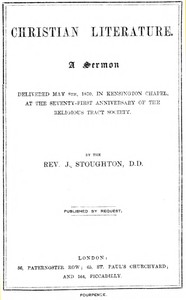
Christian Literature a sermon delivered May 8th, 1870, in Kensington Chapel, at the seventy-first anniversary of the Religious Tract Society — Themes and Context
(0 User reviews)
394
Project Gutenberg
2021
Not confirmed
Sermons, English -- 19th century; Congregational churches -- Sermons; Christian literature -- Sermons; Bible. John, XXI, 25 -- Sermons
Readers of public-domain and historical texts
Project Gutenberg digital edition
en
Edition facts
Words
11,074
Reading time
49 min
Text sections
2
The source record for Christian Literature a sermon delivered May 8th, 1870, in Kensington Chapel, at the seventy-first anniversary of the Religious Tract Society — Themes and Context measures this digital text at 11,074 words, 49 min estimated reading time, and 2 detected text sections.
The text analysis averages about 25.1 words per sentence, while the detected sections provide another way to judge how the source is divided.
Project Gutenberg metadata also associates the work with “Sermons, English -- 19th century,” connecting these edition facts with the source record’s subject description.
Source:
Project Gutenberg record #64472
John Stoughton's 1870 sermon uses John 21:25 to argue that Christian literature must be both evangelistic and culturally engaged, citing the Religious Tract Society's output and Ezekiel's river as a figure for literary influence.
Read the complete public-domain text at its original source.
Read on Project GutenbergStoughton opens his anniversary sermon by dwelling on the textual history of John 21:25, noting that the apostle appended a supplementary chapter to his Gospel and then concluded with a “strong Oriental hyperbole” about the impossibility of recording all Jesus did. This exegetical move—treating the verse as a reflection on the limits of writing—becomes the sermon’s controlling metaphor. Stoughton draws a parallel between the Evangelist’s sense of incompleteness and the experience of any author who returns to an earlier work “with a deepened belief of the truth of its contents, accompanied by an overwhelming conviction of its want of completeness.” The sermon thus frames Christian literature not as a finished monument but as an ongoing, necessarily partial response to an inexhaustible subject.
The Twofold Object of the Religious Tract Society
Stoughton distinguishes two aims that the Society has pursued since its founding. The first, conversion through direct evangelistic tracts, he calls “originally the only one, and has ever been the chief.” He singles out The Dairyman’s Daughter and The Young Cottager as exemplary works that “can never be out of date.” The second aim, “the hallowing of literature with a Christian spirit,” has grown in prominence without displacing the first. Stoughton lists the Society’s catalogue: “solid divinity, lively histories, pleasant biographies, sparkling fictions, religious, moral, and descriptive poetry.” He notes that old works are reissued under competent editors and that new works receive the Committee’s sanction. The periodicals The Leisure Hour and Sunday at Home are praised for their artistic and literary standing, “conciliating prejudice, producing favourable impressions of Christian truth.”
Numbers, Scale, and the Unfinished Task
Stoughton cites striking statistics: an annual circulation from the London depot of 41,044,772 tracts, and a seventy-one-year total of nearly 1,335,000,000. Yet he immediately undercuts any triumphalism. “It would seem, looking at these almost incredible numbers, as if the world could not contain so many books written of Him; and yet how many, many millions of the men and women in the world know nothing of Him.” He contrasts the Society’s output with “shoals … full of infidelity and superstition and vice” issuing from other presses. The rhetorical effect is to keep the Society’s work provisional: “the work of this Society is not half done.” The hyperbole of John 21:25 is thus inverted—the world cannot contain the books, but the books have not yet reached the world.
Ezekiel’s River as a Figure for Literary Influence
Stoughton turns to Ezekiel 47 for a typological image. The prophet watches waters flow from the Temple, deepening from ankle to knee to loins to a river “which could not be passed over,” and when it reaches the Dead Sea it heals the waters. Stoughton applies this directly: “Such is the Old Testament type of the Gospel of Christianity. … We venture to employ it as a figure of what this Society is doing.” The Society issues “fertilizing, life-giving, and healing streams” because it fills the world with books about what Jesus did, is doing, and will do. The quotation from Ezekiel—about trees whose leaf does not fade and fruit that is not consumed—closes the figure. The choice of this particular Old Testament passage reinforces the sermon’s insistence on gradual, cumulative, and transformative literary influence.
Diction and the Rhetoric of Restraint
Stoughton’s prose is measured and periodic, favoring balanced clauses and parallel constructions. He describes the Evangelist “reading over his own Gospel, dwelling with delight upon sacred memories … thinking of one act of his after another, one word of his after another, never written.” The repetition of “one … after another” mimics the inexhaustible list it describes. He avoids sensational language even when citing enormous numbers; the phrase “almost incredible numbers” is followed immediately by a sobering qualification. His diction is consistently elevated but not ornate: “asseveration,” “inexhaustible fulness,” “overwhelming conviction.” The sermon’s tone is that of a careful expositor who treats the Society’s work as an extension of scriptural logic rather than as a merely institutional achievement.
Readers should note that Stoughton’s sermon is not a general defense of religious reading but a historically situated argument about one Society’s dual mandate. The excerpts do not reveal whether he addresses controversies over tract content, the economics of distribution, or the reception of the Society’s fiction. His reliance on Ezekiel’s river as a controlling image suggests a preference for organic, gradual influence over direct confrontation. The sermon rewards attention to how Stoughton moves between exegesis, institutional history, and metaphor—and to the precise numbers he deploys as evidence of both success and insufficiency.
Reading Stoughton’s sermon again, I found myself thinking of how he insisted that truth must have room to breathe—that sacred words need the world’s language to reach us. It reminded me, quietly, of another old volume I once held, its title promising to blend two ways of seeing. The Story of Creation as Told By Theology and By Science — Edition Insights felt like a familiar friend in that regard. Both seemed to long for a gentler conversation.
There are no reviews for this eBook.
There are no comments for this eBook.
Reader reflection
How will you remember this book?
Save your reaction, strongest insight, and memorable passage.
Your progress
0
/
10
2
Was reading this book enjoyable?
3
Would you pass this book on to a friend?
4
How much effort did this book require?
5
Which element worked best for you?
6
Did the story or argument move comfortably?
7
How strong was your personal connection to the text?
8
Could you apply anything you learned?
9
In one sentence, what did you learn?
10