1

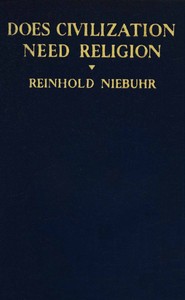
Does civilization need religion? — Story, Setting & Ideas
(0 User reviews)
1554
Project Gutenberg
2025
Not confirmed
Philosophy and religion; Christianity; Christian civilization
Readers of public-domain and historical texts
Project Gutenberg digital edition
en
Edition facts
Words
45,102
Reading time
197 min
Text sections
12
For Does civilization need religion? — Story, Setting & Ideas, the stored edition analysis reports 45,102 words, 3 hr 17 min estimated reading time, and 12 detected text sections.
The text analysis averages about 27.9 words per sentence, while the detected sections provide another way to judge how the source is divided.
Project Gutenberg metadata also associates the work with “Philosophy and religion,” connecting these edition facts with the source record’s subject description.
Source:
Project Gutenberg record #77050
Reinhold Niebuhr's 1927 study examines religion's social resources and limitations in modern life, arguing that while religious faith can inspire ethical action, it often succumbs to group loyalties and institutional conservatism. The excerpts reveal a critical analysis of how religious and secular groups alike struggle with moral hypocrisy.
Read the complete public-domain text at its original source.
Read on Project GutenbergReinhold Niebuhr opens Does Civilization Need Religion? with a blunt diagnosis: religion in modern society is not in robust health. He observes that industrial workers, when socially self-conscious, are almost universally hostile to faith, while the privileged classes grow indifferent. The opening chapter introduces a recurring structural pattern—Niebuhr pairs a claim about religion’s weakness with a countervailing observation, as when he notes that both fundamentalism and modernism betray a psychology of defeat. This dialectical movement, rather than a simple defense of religion, shapes the entire argument.
Group Loyalty as a Moral Obstacle
In the excerpt on group relations, Niebuhr develops a striking thesis: groups as such tend to be more predatory than the individuals composing them. He illustrates this with examples ranging from family covetousness to national policy. The family, he writes, is easily tempted to gain advantages at the expense of other families, and the political state is probably most inclined to unethical conduct. He cites George Washington’s dictum that a nation is not to be trusted beyond its interests, and Henry Adams’s conclusion that masses of men are always moved by interest and never by conscience. These references ground his argument in historical observation rather than abstract theory.
Niebuhr’s analysis extends to religious organizations, which he says are not free of imperial ambitions. The desire for power and prestige leads them to soften their ideals to captivate the morally mediocre majority. This critique complicates any simple answer to the book’s title question: if religion itself is subject to the same group dynamics that corrupt secular institutions, its capacity to redeem civilization is severely limited.
The Ethical Paradox of Patriotism
Niebuhr identifies a specific mechanism by which group loyalty obscures unethical conduct. The patriot identifies his tender emotions toward his nation with the attitude of the nation itself, becoming incapable of critical appraisal. Similarly, a father may feel moral pride in selfish pursuits because they benefit his family, and a business man gains a consciousness of virtue from loyalty to the firm even while conniving in predatory practices. The class-conscious worker may be willing to disrupt society in the interest of his class, all moral needs satisfied by devotion to the group.
This paradox is most serious for the nation, which is not a voluntary association and whose group is conveniently isolated from others. Niebuhr’s phrasing—that loyalty to a group can make individuals feel virtuous while the group acts unethically—anticipates later social psychology. The excerpts do not reveal whether Niebuhr offers a resolution, but they make clear that any ethical religion must confront this structural hypocrisy.
Religion’s Social Resources and Limitations
The book’s subtitle promises a study in the social resources and limitations of religion, and the excerpts show Niebuhr balancing both sides. He acknowledges that religion has historically deepened the stream of religious life, as in the Protestant Reformation, but notes that it has been narrowed as well. The opening chapter’s imagery of tides ebbing and flowing suggests a cyclical view: each new tide barely exceeds the previous ebb.
Niebuhr’s method is diagnostic rather than prescriptive. He does not claim that religion is unnecessary, but he insists on examining its failures with the same critical faculty he applies to secular institutions. The dedication to his father, who taught him that the critical faculty can be united with a reverent spirit, signals the book’s intellectual stance. Readers should expect a rigorous, unsentimental analysis that holds religion to the same ethical standards it claims to uphold.
Niebuhr’s study is best approached as a work of social ethics rather than apologetics. The excerpts suggest that he is less interested in proving religion’s necessity than in exposing the moral contradictions that both religious and secular groups share. Readers attentive to his use of historical examples—from Washington to Adams to the family—will find a thinker who grounds his arguments in concrete observation. The book’s value lies not in a final answer to its title question, but in the clarity with which it poses the problem.
Niebuhr’s old book makes me feel the weight of how easily good faith slips into group habit. I sometimes wonder if that’s why the quieter sermons stick with me longer. There’s a steady honesty in The Life of Duty, v. 2 that feels like someone sitting beside you, not above you. The Life of Duty, v. 2 A year's plain sermons on the Gospels or Epistles — A Reader’s Guide came to mind, and I just sat with that thought for a while.
There are no reviews for this eBook.
There are no comments for this eBook.
Reader reflection
How will you remember this book?
Save your reaction, strongest insight, and memorable passage.
Your progress
0
/
10
2
Was reading this book enjoyable?
3
Would you encourage someone else to read it?
4
Did the language feel accessible?
5
Did this book create an emotional response?
6
Did anything about the book feel genuinely new?
7
Did the book give you something worth debating?
8
How strong was your personal connection to the text?
9
What is the main idea you are taking away?
10