1

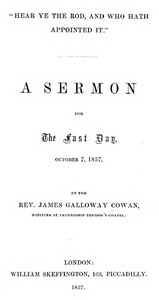
"Hear Ye the Rod, and Who Hath Appointed It" A Sermon for the Fast Day, October 7, 1857 — Themes and Context
(0 User reviews)
358
Project Gutenberg
2021
1857
Sermons, English; Church of England -- Sermons -- 19th century; Bible. Micah, VI, 9 -- Sermons; India -- History -- Sepoy Rebellion, 1857-1858 -- Sermons
Readers of public-domain and historical texts
Project Gutenberg digital edition
en
Edition facts
Words
7,835
Reading time
35 min
Text sections
1
The source record for "Hear Ye the Rod, and Who Hath Appointed It" A Sermon for the Fast Day, October 7, 1857 — Themes and Context measures this digital text at 7,835 words, 35 min estimated reading time, and 1 detected text section.
The text analysis averages about 23.0 words per sentence, while the detected sections provide another way to judge how the source is divided.
Project Gutenberg metadata also associates the work with “Sermons, English,” connecting these edition facts with the source record’s subject description.
Source:
Project Gutenberg record #64742
A Fast Day sermon from 1857 interpreting the Indian Rebellion as divine punishment, urging repentance and charitable action while wrestling with theodicy and national sin.
Read the complete public-domain text at its original source.
Read on Project GutenbergJames Galloway Cowan’s Fast Day sermon, preached on October 7, 1857, takes as its text Micah 6:9: “Hear ye the rod, and Who hath appointed it.” The sermon was delivered during the Indian Rebellion (Sepoy Mutiny) and is preserved in a single 1857 edition. Cowan, minister of Archbishop Tenison’s Chapel in London, uses the occasion to address a national crisis through a theological lens, arguing that the rebellion is a divine rod of punishment. The catalog subjects list the sermon under Church of England homiletics and the Sepoy Rebellion, but the text itself is less a historical account than a sustained meditation on providence, national sin, and the proper Christian response to calamity.
Providence and National Accountability
Cowan opens with a dense statement of belief in a God who rules through both fixed laws and “active special interferences in particular cases.” This is not a deist clockmaker deity but one who intervenes directly in history. The sermon insists that nations, having only temporal existence, are “always ultimately dealt with here according to their deserts.” This framework allows Cowan to interpret the rebellion as a just punishment for British sins—a position that might surprise modern readers expecting a purely patriotic or jingoistic sermon. He explicitly warns that if prayers for victory are not accompanied by repentance, it would be better to lose India than to have it “given back to us in anger.” The logic is rigorously theodical: God uses existing elements—natural forces or human actions—as instruments of reward and punishment.
The Rhetoric of Repentance and Reform
Cowan’s call to prayer is conditional: prayers must be “righteous,” not merely penitent but resolved to “provoke punishment no longer.” He imagines the proper prayer as a pledge: “We have done wrong, we repent, we pledge ourselves to amend.” The sermon then pivots to action, urging the congregation to support a relief fund for survivors—especially “gentle, delicate women” and “helpless babes” left destitute. This shift from theological abstraction to concrete charity is the sermon’s most specific practical demand. Cowan’s language is vivid: he describes survivors “huddled together in one room,” their minds “distracted with the remembrance of the atrocities.” He appeals to the “Great Sympathiser” and warns that withholding aid contradicts the love of God.
A Sermon’s Structure and Audience
The sermon follows a clear homiletic arc: doctrinal foundation, application to current events, and exhortation to action. Cowan addresses his congregation as “my brethren” and assumes shared beliefs about providence and scripture. The text is dense with subordinate clauses and theological reasoning, suggesting an educated, attentive audience. Notably, the sermon does not describe the rebellion’s events in detail; it assumes listeners already know the news. Instead, it focuses on interpretation and response. The closing paragraphs shift to a direct appeal for donations, naming a specific relief fund. This blend of doctrinal exposition and urgent charity gives the sermon a dual character: it is both a theological treatise on divine justice and a practical fundraising appeal.
Cowan’s sermon is best read as a primary document of mid-Victorian religious response to imperial crisis. Its interest lies less in its historical claims about the rebellion than in its theological logic and rhetorical strategy. Readers should note how Cowan balances national guilt with calls for mercy, and how he moves from abstract providence to a concrete request for money. The sermon reveals the assumptions of a clergyman trying to make sense of catastrophe without abandoning either his faith or his empire.
I have often found myself returning to that stern 1857 sermon, its cry of national reckoning so heavy in the air. Yet it always steers me toward a quieter shelf, where a Lancashire companion whispers of shared burdens rather than divine rods. The same weight, but carried with human hands. "Bear ye one another's burdens." A Plain Sermon on the Lancashire Distress — Reading Companion feels like the warm answer to that cold question.
There are no reviews for this eBook.
There are no comments for this eBook.
Reader reflection
How did this book work for you?
Your answers remain private and are stored only in this browser.
Your progress
0
/
10
2
How did the book work for you overall?
3
Would you encourage someone else to read it?
4
How demanding did the text feel?
5
Did the book deliver what you hoped for?
6
How understandable was the text?
7
What did you think about the pace?
8
What was its emotional impact?
9
Which lesson or insight stayed with you?
10