1

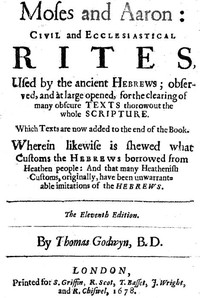
Moses and Aaron: Civil and Ecclesiastical Rites, Used by the Ancient Hebrews — A Closer Reading
(0 User reviews)
1435
Project Gutenberg
2016
Not confirmed
Worship in the Bible -- Early works to 1800; Judaism -- Early works to 1800; Judaism -- Customs and practices -- Early works to 1800; Rites and ceremonies in the Bible -- Early works to 1800
Readers of public-domain and historical texts
Project Gutenberg digital edition
en
Edition facts
Words
84,771
Reading time
369 min
Text sections
20
This digital edition of Moses and Aaron: Civil and Ecclesiastical Rites, Used by the Ancient Hebrews — A Closer Reading is described by source-level measurements including 84,771 words, 6 hr 9 min estimated reading time, and 20 detected text sections.
The text analysis averages about 20.8 words per sentence, while the detected sections provide another way to judge how the source is divided.
Project Gutenberg metadata also associates the work with “Worship in the Bible -- Early works to 1800,” connecting these edition facts with the source record’s subject description.
Source:
Project Gutenberg record #52639
Thomas Godwyn's 17th-century study of Hebrew rites examines biblical customs through comparative analysis, using Moloch worship and Gehenna to illustrate how ancient practices illuminate scriptural obscurities.
Read the complete public-domain text at its original source.
Read on Project GutenbergThomas Godwyn’s Moses and Aaron opens with a striking claim: unfamiliarity with ancient Hebrew customs makes readers strangers to Christ and his Apostles. The work proceeds to treat biblical rites not as antiquarian curiosities but as keys that transform obscure passages into “sweet invitements” for sustained Scripture reading. Godwyn’s method is comparative and structural, tracing how heathen nations borrowed from—or perverted—Hebrew practices, and how those borrowings clarify the biblical text.
Comparative Idolatry: Moloch and Saturn
Godwyn devotes sustained attention to the idol Moloch, drawing parallels with Saturn’s cult. He cites multiple sources—Macrobius, Eusebius, Jalkut—to show that both deities were represented as hollow brass images with outstretched hands, into which children were cast to be burnt. The description is precise: Moloch’s image had seven chapels, each corresponding to a different offering, from a fowl to a son. Godwyn notes that the Persians honored the Sun with seven gates, suggesting a mystical correspondence between the chapels and the seven planets, with Moloch as “the King and Prince” of them. This comparative approach does not merely list similarities but probes the structural logic of idolatrous systems, showing how architectural and ritual details encode cosmological beliefs.
Tophet, Gehenna, and the Echoes of Hell
The name Tophet, Godwyn explains, derives from a Hebrew word for drum, because priests beat tabrets to drown the cries of sacrificed children. The valley of Gehenna, from gai (valley) and naham (roaring), became synonymous with hellfire. Godwyn then addresses a question: does the New Testament phrase “fire of Gehenna” (Matthew 5:22) originate from Moloch’s fire? He answers cautiously, arguing that while the bitter cries of infants shadow hell’s torments, the perpetuity of hellish pains is signified by a different fire—the one kept continually burning outside Jerusalem for consuming carcasses and filth. This distinction reveals Godwyn’s method: he separates literal practice from theological metaphor, grounding New Testament language in observable, physical realities of ancient Jerusalem.
The Cabalists and the Seven Mansions of Gehenna
Godwyn introduces Cabalistic interpretations of Gehenna, distinguishing between a “superior” Gehenna (bodily torments in this world) and an “inferior” one (pains of the soul in the world to come). He lists seven mansion places: Infernus, Perditio, Profundum, Taciturnitas, Umbra mortis, Terra inferior, and Terra sitiens. The list is presented without endorsement; Godwyn remarks that “he that will mispend his time may read according to the quotation.” This dry aside signals his own stance: he reports the Cabalistic schema but distances himself from its speculative elaboration. The passage illustrates how Moses and Aaron weaves together rabbinic, classical, and patristic sources, often leaving the reader to weigh the authority of each.
Structure and Movement: From Rite to Text
The book’s structure moves from the Tabernacle and priesthood to festivals, sacrifices, and civil laws, but its deeper movement is from material practice to textual interpretation. Godwyn repeatedly uses a three-step pattern: describe a rite, cite a biblical passage that alludes to it, then show how the rite resolves the passage’s obscurity. For example, the discussion of Moloch begins with the image’s form, then cites Jeremiah’s reference to Tophet, then explains how the drumming and crying inform our reading of Gehenna in the Gospels. This pattern makes the book a practical hermeneutic tool rather than a mere encyclopedia. The reader is trained to see ritual details as exegetical keys, a method Godwyn explicitly advocates in his preface.
Readers approaching Moses and Aaron will find it most useful as a companion to Scripture rather than as a standalone treatise. Godwyn’s dense cross-references and marginal notes reward slow reading; the index of biblical texts at the end allows one to start from a difficult verse and trace its ritual background. The work’s value lies not in its theological conclusions but in its patient reconstruction of a world where every lampstand, sacrifice, and garment carried meaning that the original audience would have recognized instantly.
The rain drummed on the windows that afternoon while I followed Godwyn’s careful threading of Moloch into Gehenna, the old words suddenly vivid. It felt less like scholarship than a quiet hand reaching back through centuries. Later, idly, I picked up The Believer Not Ashamed of the Gospel — A Reader’s Guide and saw that same unblinking patience in another guise, a restful kind of courage.
There are no reviews for this eBook.
There are no comments for this eBook.
Reader reflection
Your personal reading reflection
Build a private reading journal entry for this title.
Your progress
0
/
10
2
Did this book hold your interest?
3
Would you recommend this book to another reader?
4
How much effort did this book require?
5
Which aspect of the book did you value most?
6
Did you relate to its people, ideas, or situations?
7
Was the book what you thought it would be?
8
Did you gain anything practical from the text?
9
Which lesson or insight stayed with you?
10