1

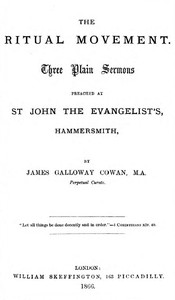
The Ritual Movement Three plain sermons preached at St. John the Evangelist's, Hammersmith — Themes and Context
(0 User reviews)
325
Project Gutenberg
2021
Not confirmed
Sermons, English; Church of England -- Sermons -- 19th century; Bible. Corinthians, 1st, XIV, 40 -- Sermons; Ritualism -- Sermons
Readers of public-domain and historical texts
Project Gutenberg digital edition
en
Edition facts
Words
12,773
Reading time
56 min
Text sections
2
Before opening The Ritual Movement Three plain sermons preached at St. John the Evangelist's, Hammersmith — Themes and Context, the edition data offers a quick orientation: 12,773 words, 56 min estimated reading time, and 2 detected text sections.
The text analysis averages about 36.1 words per sentence, while the detected sections provide another way to judge how the source is divided.
Project Gutenberg metadata also associates the work with “Sermons, English,” connecting these edition facts with the source record’s subject description.
Source:
Project Gutenberg record #64741
An 1866 sermon series by James Galloway Cowan examining the Ritual Movement through the lens of 1 Corinthians 14:40, arguing for decorum and order while critiquing both resistance to change and unthinking innovation.
Read the complete public-domain text at its original source.
Read on Project GutenbergJames Galloway Cowan’s three plain sermons, preached at St John the Evangelist’s, Hammersmith, in 1866, take the Apostle Paul’s injunction that “all things be done decently and in order” as their recurring textual anchor. Cowan does not offer a neutral survey of the Ritual Movement; he positions himself as a mediator between two parties he calls “the standers still” and “the hurriers along.” His diction repeatedly pairs moral and liturgical categories: “anarchy, lawlessness, pride, self-will” are set against “decorously” and “according to system and appointment.” The sermons are structured as a sustained application of a single verse to a contemporary controversy, with each sermon narrowing from general principle to specific Anglican circumstance.
The Corinthian Parallel as Rhetorical Frame
Cowan opens by drawing a direct analogy between the Corinthian church and the Anglican Church of his day. The Corinthians, he says, were “divinely distinguished by the number and excellence of the spiritual gifts” yet “distinguished themselves by anarchy, lawlessness, pride, self-will, self-sufficiency, uncharitableness, ecclesiastical and moral laxity.” The parallelism is exact: Anglicans have been “distinguished by God” with “conspicuous and super-excellent gifts and privileges,” yet they too are “constantly distinguishing ourselves by strifes, irregularities, and miserable assertions of self’s importance.” This rhetorical move allows Cowan to treat the Ritual Movement not as a novel dispute but as a recurrence of a perennial ecclesiastical failing. He does not name specific ritualist practices in this opening; instead, he frames the entire controversy as a failure to observe the apostolic rule. The effect is to elevate the debate from practical disagreements over vestments or gestures to a matter of fundamental Christian order.
Two Audiences, One Precept
Cowan explicitly divides his congregation—and by extension his readership—into two groups. To the “standers still,” the “old-fashioned” who are “contented with things as they were,” he poses the question: “what mean ye by the service of God in the sanctuary?” The incomplete sentence in the excerpt suggests he goes on to challenge their complacency. To the “hurriers along,” he implies a warning against being “hurried along without due care to consider, perhaps without time to consider, whither they were tending.” This balanced address is characteristic of the sermons’ structure: Cowan avoids taking a partisan stance, instead using the apostolic precept as a corrective for both inertia and haste. His language remains concrete—he speaks of “obloquy” faced by clergy loyal to the Church of the Reformers—and he prays that “those in authority may have wisdom” and “those under authority may have grace to render all due submission.” The sermons thus function as a homiletic appeal to a middle way, grounded in the authority of the biblical text.
Reformation History as a Cautionary Tale
In the third sermon, Cowan turns to the English Reformation to argue that the Anglican Church was founded on a principle of conservative reform. The Reformers, he claims, acted “with the sanction, under the immediate direction of the highest authorities in Church and State; by men of sound faith, sober judgment, and calm temperament.” They maintained “whatever of doctrine or practice had universally prevailed among Christians” and avoided “differing unnecessarily, even in non-essentials, from the mediæval Church.” This historical narrative serves to distinguish Anglicanism from what Cowan calls “a radical and mere Protestant spirit.” He acknowledges that the Reformers did “protest” against “prevailing corruptions and superstitions,” but insists that their Protestantism “only asserted what they were not.” The true Anglican identity, in his telling, is Catholic—a term he claims for his own tradition against those who “henceforth claimed the exclusive right to it.” The foreign Reformation, by contrast, is portrayed as “revolutionary and indiscriminate,” seeking “to destroy, root and branch, whatever was old.” Cowan’s language here is notably concessive: he allows that “earnest and holy men” were driven by “awakened feeling,” but he ultimately presents their course as unguided by “Catholic influence” or “intelligent principle.”
Diction of Decorum and Its Opposites
Throughout the sermons, Cowan’s lexical choices reinforce his central argument. The key terms are “decently” and “in order,” which he glosses as “decorously” and “according to system and appointment.” Their opposites form a litany of disorder: “anarchy, lawlessness, pride, self-will, self-sufficiency, uncharitableness, ecclesiastical and moral laxity.” This binary is not merely descriptive but evaluative: to be “old-fashioned” is to be “contented with things as they were,” a phrase that carries a hint of reproach; to be a “hurrier along” is to lack “due care.” Cowan also employs the language of sight and appearance: the Ritual Movement “wears the appearance of strange and even dangerous innovation.” The verb “wears” is telling—it suggests that the movement’s novelty may be superficial, a matter of outward show rather than substance. This aligns with his broader concern for the visible order of worship, but it also reflects a preacher’s instinct to probe beneath surfaces. The sermons are thus as much about the proper disposition of the heart as about the arrangement of the sanctuary.
Cowan’s sermons are best read as a period piece that illuminates the rhetorical strategies of a moderate Anglican clergyman navigating a divisive controversy. Readers interested in Victorian religious history will find here a concrete example of how biblical exegesis was mobilized to address contemporary church politics. The sermons’ brevity—three plain discourses totaling under 13,000 words—makes them accessible, but their argumentative density rewards careful attention to Cowan’s use of analogy, historical narrative, and lexical contrast.
This sermon’s insistence on order, on the how rather than the what, brought back those warm afternoons reading about rituals in translation—the care in a chant, the weight of a gesture. Another book stirred that same patience once: Buddhism, in Its Connexion with Brahmanism and Hinduism, and in Its Contrast with Christianity — Reading Companion. It felt less like doctrine, more like a quiet room where belief simply breathed.
There are no reviews for this eBook.
There are no comments for this eBook.
Reader reflection
How did this book work for you?
Your answers remain private and are stored only in this browser.
Your progress
0
/
10
2
Did this book hold your interest?
3
Would you encourage someone else to read it?
4
How easy was the book to follow?
5
How original did the book feel?
6
Did the book give you something worth debating?
7
Did the book meet your expectations?
8
How would you describe its reading pace?
9
Which lesson or insight stayed with you?
10