1

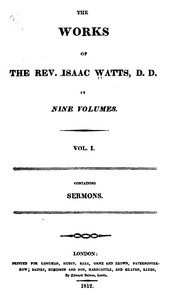
The works of the Rev. Isaac Watts, D. D. in nine volumes (volume 1 of 9) — Text and Context
(0 User reviews)
1319
Project Gutenberg
2025
Not confirmed
Theology -- Early works to 1800; Sermons, English -- 18th century; Theology -- History -- 18th century; Dissenters, Religious -- England
Readers of public-domain and historical texts
Project Gutenberg digital edition
en
Edition facts
Words
323,946
Reading time
1409 min
Text sections
56
Before opening The works of the Rev. Isaac Watts, D. D. in nine volumes (volume 1 of 9) — Text and Context, the edition data offers a quick orientation: 323,946 words, 23 hr 29 min estimated reading time, and 56 detected text sections.
The text analysis averages about 30.6 words per sentence, while the detected sections provide another way to judge how the source is divided.
Project Gutenberg metadata also associates the work with “Theology -- Early works to 1800,” connecting these edition facts with the source record’s subject description.
Source:
Project Gutenberg record #77103
This volume collects forty-three sermons by Isaac Watts, revealing his rhetorical strategies: vivid scriptural exposition, moral urgency, and a direct, admonitory tone aimed at fostering sincerity and truthfulness in Christian life.
Read the complete public-domain text at its original source.
Read on Project GutenbergIsaac Watts’s sermons in this first volume of his collected works are marked by a distinctive rhetorical intensity. In a passage on hypocrisy, Watts amplifies Christ’s language, calling hypocrites “sons of the old serpent” and linking falsehood to the devil’s original lie. He does not merely cite Scripture but dramatizes it, as when he imagines Christ saying, “The first lie that ever was made, was made by the devil; and by his telling a lie, and our mother Eve’s believing it, he murdered mankind.” This fusion of exegesis and moral exhortation is characteristic of Watts’s pulpit style.
Throughout the sermons, Watts repeatedly places his hearers “under the immediate eye of God,” urging them to consider divine judgment as a present reality. His language is concrete and urgent: God “records” every false word “in his book against that great and terrible day of account.” The sermons thus function as both theological instruction and a call to self-examination, with Watts employing vivid imagery and direct address to move his audience toward repentance and sincerity.
Rhetorical Strategies in the Sermons
Watts’s sermons are carefully structured to persuade and admonish. He often moves from a scriptural text to a series of “general heads” or divisions, each expounded with examples and applications. In the excerpt on truthfulness, he proposes four heads: the nature of truth, the sins against it, the motives to practice it, and directions for preserving it. This logical framework gives his sermons a clear, memorable shape. Within that structure, Watts uses repetition and amplification for emotional effect. For instance, he piles up synonyms for falsehood—“hypocrisy,” “deceit,” “lying”—and contrasts them with “sincerity” and “faithfulness.” He also employs rhetorical questions and direct address (“Whensoever therefore we find a temptation to falsehood, let us set ourselves under the immediate eye of God”). These techniques create a sense of urgency and personal accountability, making the sermon feel like a conversation between pastor and congregation.
The Use of Scripture as a Weapon
Watts wields biblical quotations not as ornaments but as authoritative proofs. In the excerpt, he strings together passages from John, Matthew, Revelation, and Corinthians to build a cumulative case against lying. He does not simply cite verses; he interprets them dramatically. For example, he reads Christ’s woe against the Pharisees as a direct indictment of hypocrisy, and he treats the “lake of fire” in Revelation as a literal warning. Watts also draws typological connections: the devil is “the father of lies,” and hypocrites are “sons of the old serpent.” This typological reading gives his moral arguments a cosmic dimension. At the same time, he balances threat with promise, urging readers to meditate on Christ’s “faithfulness to all his promises” as a motive for truthfulness. The sermons thus oscillate between fear and hope, using Scripture to enforce both.
Moral Psychology and the Inner Life
Watts is deeply concerned with the inner state of the believer. He speaks of “the hidden hypocrisy, the lurking deceit of the soul” and insists that God “shall judge the secrets of every heart.” This focus on interiority is central to his pastoral method. He does not merely condemn outward acts but probes the motives behind them. In the excerpt, he warns against falsehood not only in speech but in “the inward conviction of your own consciences.” Watts’s psychology is Augustinian: sin originates in the will, and the remedy is a transformed heart. He calls for “repentance for our past iniquities” and a “love of truth” cultivated through meditation on Christ’s faithfulness. The sermons thus function as a kind of spiritual therapy, guiding the listener from self-deception to sincerity. Watts’s language of “melted” hearts and “moulded” affections reveals his belief in the gradual, affective nature of moral change.
The Preacher’s Persona and Authority
Watts constructs a persona of earnest, learned authority. He speaks as a minister who has studied Scripture deeply and who feels the weight of his responsibility. His tone is paternal but not condescending; he includes himself in the warnings (“let us set ourselves”). He also displays his learning by citing multiple biblical books and by using logical divisions. Yet his authority is not merely intellectual. He appeals to shared experience, as when he says, “If we did but always place ourselves as in the sight of the great and dreadful God.” This “if” implies that his hearers already know they should do this but fail. Watts’s authority thus rests on his ability to articulate what his congregation already dimly perceives. He reinforces this by invoking the “dreadful threatenings” of Christ and the “killing reproaches” against hypocrites, aligning himself with the prophetic tradition. The sermons are thus performances of pastoral care, blending instruction, warning, and encouragement.
Readers approaching this volume should attend to the interplay between Watts’s logical structure and his emotional force. His sermons reward slow reading: the scriptural allusions are dense, and the moral arguments build cumulatively. Notice how he varies his tone—from stern denunciation to tender invitation—and how he uses repetition to drive home key points. The volume offers a window into eighteenth-century Dissenting homiletics, where the preacher’s task was to make the biblical text immediate and personally demanding. Watts’s voice, though rooted in his time, still speaks with clarity and urgency.
I remember sitting in my grandfather’s study, the dust motes floating over his worn Bible, and feeling the weight of Watts’ insistence on honesty. That same hushed gravity returned when I later held a different sacred text, The Life or Legend of Gaudama, the Buddha of the Burmese (Volume I) — Story, Setting & Ideas, where the striving for truth felt equally tender and demanding, like a familiar old ache.
There are no reviews for this eBook.
There are no comments for this eBook.
Reader reflection
How did this book work for you?
Your answers remain private and are stored only in this browser.
Your progress
0
/
10
2
What was your overall reaction to the book?
3
How likely are you to recommend this book?
4
Did the language feel accessible?
5
Did the book meet your expectations?
6
Did the book offer a fresh perspective?
7
Would a second reading be valuable?
8
Did you gain anything practical from the text?
9
What did this book teach you most?
10