1

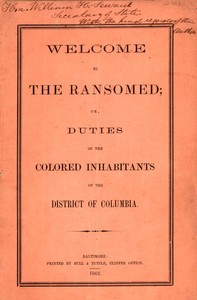
Welcome to the ransomed; or, Duties of the colored inhabitants of the District of Columbia — Background and Themes
(0 User reviews)
346
Project Gutenberg
2022
Not confirmed
Slavery -- Washington (D.C.); Sermons, American -- 19th century; United States -- History -- Civil War, 1861-1865 -- Religious aspects; African Americans -- Washington (D.C.); Freed persons -- Washington (D.C.); Washington (D.C.) -- Race relations; Bible. Timothy, 1st, II, 1-4 -- Sermons
Readers of public-domain and historical texts
Project Gutenberg digital edition
en
Edition facts
Words
7,626
Reading time
34 min
Text sections
4
Before opening Welcome to the ransomed; or, Duties of the colored inhabitants of the District of Columbia — Background and Themes, the edition data offers a quick orientation: 7,626 words, 34 min estimated reading time, and 4 detected text sections.
The text analysis averages about 23.1 words per sentence, while the detected sections provide another way to judge how the source is divided.
Project Gutenberg metadata also associates the work with “Slavery -- Washington (D.C.),” connecting these edition facts with the source record’s subject description.
Source:
Project Gutenberg record #69453
This 1862 sermon by Bishop Daniel A. Payne, preached on a day of Thanksgiving for emancipation in the District of Columbia, uses 1 Timothy 2:1-4 to exhort freedpeople to prayer, godliness, and honesty toward civil authorities, blending biblical exegesis with urgent practical counsel.
Read the complete public-domain text at its original source.
Read on Project GutenbergBishop Daniel A. Payne delivered this sermon on April 13, 1862, at the A. M. E. Ebenezer Church in Georgetown, D.C., on a day set apart by colored churches for thanksgiving and prayer in view of emancipation in the District. The text is 1 Timothy 2:1-4, which Payne reads as a command to offer supplications, prayers, intercessions, and thanks for all men—including governing authorities. The sermon’s title, Welcome to the Ransomed, frames emancipation as a divine act, but Payne immediately turns from celebration to duty, insisting that freedom must be matched by godly conduct.
Payne’s language is direct and homiletic, mixing doctrinal exposition with pointed application. He amplifies the biblical text with historical examples, such as the story of John Knox praying for Scotland’s deliverance, and with moral maxims like “Honesty is the only policy of godliness.” The sermon was published at the request of James Lynch and other congregants, who found it “appropriate” and full of “valuable practical advice.”
A Sermon Born from a Specific Occasion
The sermon’s origin is unusually well documented. A letter from James Lynch, Plato Lee, and others, dated April 14, 1862, requests publication of the discourse preached “on Sabbath last.” Payne’s reply, dated April 18, confirms he has amplified some thoughts and added notes. This exchange reveals that the sermon was not a general treatise but a direct response to the emancipation act in the District of Columbia, which took effect on April 16, 1862. The occasion—a day of thanksgiving and prayer—shapes the sermon’s dual emphasis: gratitude for liberation and instruction on the responsibilities that follow.
Payne’s choice of 1 Timothy 2:1-4 is strategic. The passage commands prayer for all people, including kings and those in authority, which Payne applies to the newly freed population. He argues that such prayer is “God-like” because God loves all mankind. The sermon thus reframes political obedience as a spiritual duty, urging his hearers to pray for the very government that had enslaved them.
Diction: Direct Address and Moral Imperatives
Payne’s diction is marked by direct address and imperative verbs. He repeatedly uses “we” to include himself and his congregation, as in “we must pray for these Authorities.” But he also shifts to the second person: “Colored men, write this sentiment upon your hearts, engrave it in your memory.” This shift creates intimacy and urgency, as if Payne is speaking to each listener individually.
His vocabulary blends theological terms with plain speech. Words like “supplications,” “intercessions,” and “godliness” sit alongside “quietude,” “policy,” and “safe.” The phrase “Honesty is the only policy of godliness” is a memorable aphorism that condenses his argument: outward morality flows from inward faith. Payne also uses repetition for emphasis, as in “good in itself; good in its effects, always good.”
Voice: The Pastor as Public Moralist
Payne’s voice oscillates between that of a pastor comforting his flock and a moralist instructing a community. He offers reassurance: “We all desire it, and therefore it is our duty to labor for it.” But he also issues warnings, quoting Dr. Adam Bluche on the dangers of rebellion: “Rebellions and insurrections seldom terminate even in political good.” This caution reflects the precarious position of freedpeople in 1862, still surrounded by slavery in neighboring states.
Payne’s use of historical example—the story of John Knox—serves to model faithful prayer. Knox “used to be in such an agony for the deliverance of his country that he could not sleep.” By linking Knox’s experience to the congregation’s, Payne validates their own anxieties while directing them toward prayer rather than action. The voice is authoritative but not domineering; Payne presents himself as a fellow Christian under the same biblical commands.
Structure: Exegesis, Application, and Motive
The sermon follows a clear expository structure. Payne first explains the context of 1 Timothy, noting that Paul wrote to instruct Timothy about false doctrines and the qualifications of ministry. He then identifies the “foremost” duty: prayer for all men. The body of the sermon unpacks four motives for this duty, each introduced with a numbered point: (1) “that we may lead a quiet and peaceable life,” (2) “that we may live in all godliness and honesty,” (3) “that it is good and acceptable in the sight of God,” and (4) that God “will have all men to be saved.”
Each motive is supported by a short explanation and often a quotation or example. For instance, the second motive leads to a discussion of honesty as the fruit of godliness. The fourth motive expands into a prayer that authorities themselves may be saved. This structure makes the sermon easy to follow and remember, suited to oral delivery. Payne’s notes, added for the pamphlet, likely provide further scriptural or historical support.
Readers approaching this sermon should attend to its occasional nature: it is a document of a specific historical moment, when emancipation in the District of Columbia was newly enacted. Payne’s emphasis on prayer and obedience may seem conservative, but it reflects a strategic choice to advocate for moral uplift as the path to lasting freedom. The sermon rewards close reading for its blend of biblical interpretation, rhetorical skill, and pastoral care. Pay attention to how Payne uses scripture to address the concrete circumstances of his audience, and consider the tensions between gratitude and caution that run through his words.
That sermon about the freedpeople in Washington—how practical and tender it felt, this call to live quietly and honestly inside a brand-new freedom. It stayed with me, that balance. I kept thinking about the gentle patience required, and somehow it reminded me of the old essays in Toleration and other essays — Key Ideas to Explore, where forbearance becomes a quiet daily craft. A soft echo, really.
There are no reviews for this eBook.
There are no comments for this eBook.
Reader reflection
How will you remember this book?
Save your reaction, strongest insight, and memorable passage.
Your progress
0
/
10
2
What was your overall reaction to the book?
3
How likely are you to recommend this book?
4
How demanding did the text feel?
5
Could you follow the author’s main argument?
6
Is this a title worth rereading?
7
How strong was your personal connection to the text?
8
Did anything about the book feel genuinely new?
9
In one sentence, what did you learn?
10