1

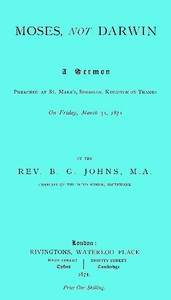
Moses, not Darwin A sermon preached at St. Mark's, Surbiton, Kingston-on-Thames on Friday, March 31, 1871 — Inside the Classic
(0 User reviews)
1039
Project Gutenberg
2021
1871
Evolution; Creation; Sermons, English -- 19th century; Church of England -- Sermons -- 19th century; Bible. Genesis, II, 7 -- Sermons
Readers of public-domain and historical texts
Project Gutenberg digital edition
en
Edition facts
Words
7,720
Reading time
34 min
Text sections
1
The source record for Moses, not Darwin A sermon preached at St. Mark's, Surbiton, Kingston-on-Thames on Friday, March 31, 1871 — Inside the Classic measures this digital text at 7,720 words, 34 min estimated reading time, and 1 detected text section.
The text analysis averages about 32.4 words per sentence, while the detected sections provide another way to judge how the source is divided.
Project Gutenberg metadata also associates the work with “Evolution,” connecting these edition facts with the source record’s subject description.
Source:
Project Gutenberg record #64496
An 1871 sermon by Rev. B. G. Johns arguing that Genesis 2:7, not Darwinian evolution, explains human origins. Johns contrasts the 'noble and grand words' of scripture with what he calls the 'shallow and flippant' philosophy of natural selection, insisting on an unbridgeable gulf between humans and animals.
Read the complete public-domain text at its original source.
Read on Project GutenbergThe sermon opens with a close reading of Genesis 2:7, which Johns calls 'noble and grand words, noble in their strength and in their simplicity.' He immediately distinguishes human creation from that of other creatures, emphasizing that God 'breathed into him the breath of life, and man became a living soul.' This phrase becomes the sermon's refrain, repeated verbatim at key moments. Johns then pivots to critique what he sees as a common but shallow acknowledgment of the soul among worldly people—a 'fluent talk' that postpones genuine spiritual commitment. The rhetorical structure is established early: Johns moves from scriptural exegesis to moral application, then to polemic against evolutionary theory.
The Rhetoric of Certainty
Johns employs a declarative, homiletic voice that brooks little ambiguity. His sentences often begin with 'Thus,' 'Yet,' or 'But, still,' creating a rhythm of assertion and rebuttal. For example, after describing the 'infinite gulf' between humans and animals, he declares: 'Yet, my brethren, the gulf remains. God has drawn the line between man and beast, and no human power can abolish it.' This pattern—state a position, anticipate an objection, then reassert—gives the sermon a forensic quality. Johns also uses rhetorical questions to dismiss opposing views: 'Where is one, only one, such monstrosity… who is even remotely beginning to grow into human likeness or shape?' The questions are not meant to invite answer but to underscore the absurdity of evolutionary claims.
Pace and Accumulation
The sermon's pace shifts markedly between sections. Early passages are measured, with Johns unpacking the Genesis text in long, periodic sentences that build toward a climax: 'the whole living man, the body in its strength, pride, and beauty; the mind, the keen reason, the swift intelligence, the glowing imagination; and the soul…' This accumulation of clauses mirrors the creation he describes—layered and deliberate. Later, when Johns turns to attack Darwinism, the pace quickens. Sentences become shorter, more staccato: 'No such being has ever been found… A gulf not to be crossed but by the shallow and flippant philosopher.' The final paragraphs slow again, returning to a consolatory tone: 'let us be content with this hope.' This rhythmic variation keeps the congregation engaged through a single, sustained argument.
Imagery of Light and Darkness
Johns repeatedly contrasts light with darkness to frame his theological argument. The face of a child bears 'the imperishable marks of God's handiwork, and the beauty, and freshness, and innocence shine out, till we think of the faces of the Blessed before the Throne on high.' Evolutionary theory, by contrast, leads to 'confusion, darkness, and shame.' The 'breath of life' is itself a luminous image—a divine spark that lifts humans above brute creation. Johns extends this metaphor to the afterlife: believers receive 'the rapture of immortality,' while deniers face 'darkness.' The imagery is not merely decorative; it reinforces the sermon's central claim that humans are fundamentally spiritual beings, illuminated by God's direct action, not products of a blind, material process.
Readers should note that this sermon represents a specific moment in the Victorian reception of Darwinism—a clerical response that relies on rhetorical force rather than scientific counterargument. Johns never engages with On the Origin of Species directly; instead, he caricatures evolutionary theory as a creed of 'eat, then, drink, and to-morrow die.' The sermon's power lies in its pulpit oratory: the repetition of key phrases, the rhythmic shifts in pace, and the stark binary between divine creation and soulless materialism. For those interested in the intersection of religion and science in the 1870s, this text offers a vivid example of how one clergyman used the language of scripture to resist a paradigm shift.
Holding this 1871 sermon, I remembered my grandfather’s worn Bible, its margins filled with his quiet doubts about progress. He’d have found kinship in Johns’s insistence on a sacred gap between us and the animals. That same yearning for dignity surfaces in Welcome to the ransomed; or, Duties of the colored inhabitants of the District of Columbia — Background and Themes, where another voice claims a fixed, human worth against the era’s casual reductions.
There are no reviews for this eBook.
There are no comments for this eBook.
Reader reflection
How will you remember this book?
Save your reaction, strongest insight, and memorable passage.
Your progress
0
/
10
2
What was your overall reaction to the book?
3
Is this a title you would suggest to others?
4
What was the reading difficulty like?
5
Did anything about the book feel genuinely new?
6
Would this book work well in a reading group?
7
What did you appreciate most?
8
How strong was your personal connection to the text?
9
Which lesson or insight stayed with you?
10