About 197 minutes
Does civilization need religion? — Story, Setting & Ideas
Theology
45,102 recorded words. 0 minutes difference from this book's estimate.
View Gutenberg source #77050
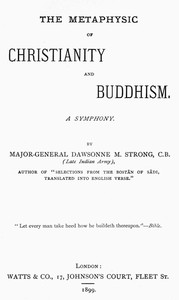
This digital edition of The Metaphysic of Christianity and Buddhism: A Symphony — Reading Notes is described by source-level measurements including 45,195 words, 3 hr 17 min estimated reading time, and 12 detected text sections.
The text analysis averages about 26.2 words per sentence, while the detected sections provide another way to judge how the source is divided.
Project Gutenberg metadata also associates the work with “Christianity,” connecting these edition facts with the source record’s subject description.
Explore this collection
These alternatives are selected using recorded categories and estimated reading time.
About 197 minutes
Theology
45,102 recorded words. 0 minutes difference from this book's estimate.
View Gutenberg source #77050About 180 minutes
Theology
41,288 recorded words. 17 minutes difference from this book's estimate.
View Gutenberg source #10274About 180 minutes
Theology
41,323 recorded words. 17 minutes difference from this book's estimate.
View Gutenberg source #13539Search stored excerpts and compare books → Choose by your preferences →
Choices use stored catalog measurements. Estimates vary with reading speed. A shared category is a catalog label, not a claim that two books have the same argument or literary quality.
Search reads excerpt text stored with this catalog and links to its associated Gutenberg record. The connection is stored in the site database; this tool does not recheck that every excerpt is word-for-word identical to that external record. Excerpt search does not cover every chapter and does not verify historical publication dates.
Catalog snapshot checked: 2026-09-25. Coverage: 90 public books, 90 available source excerpts.
Read the complete public-domain text at its original source.
Read on Project GutenbergMajor-General Dawsonne M. Strong opens his 1899 work with a frank admission: a sincere Christian faces an 'almost insuperable obstacle' when trying to associate equal holiness with other faiths. Yet the book proceeds to build bridges through metaphysical analysis rather than devotional argument. Strong draws on biblical texts, Buddhist scripture, and Western commentators like Dr. Paul Carus, framing his inquiry as a 'symphony'—a term that suggests harmony without unison.
The author's background as a late Indian Army officer and translator of Persian poetry (the Bostān of Saadi) informs his approach. He quotes Omar Khayyam and the Milinda Panha dialogue between King Menander and the sage Nagasena, using the flame-and-lamp analogy to illustrate Buddhist continuity without a permanent self. The excerpts show a writer more interested in philosophical parallels than conversion or critique.
Strong organizes his argument into five chapters plus an appendix of metrical adaptations. The chapter titles—'Jesus and Gotama,' 'God and the Kosmos,' 'Soul, Self, Individuality, and Karma,' 'Heaven and Nirvana'—reveal a paired-comparison structure. Each pairs a Christian concept with a Buddhist one, but the excerpts suggest Strong avoids simple equivalence. In the introduction, he cites George Sand's French epigraph about differing forms but shared eternal principles, signaling a nuanced approach.
The appendix includes six poems, such as 'The Last Words of Gotama Buddha to his Favourite Disciple Ananda' and 'Samsâra and Nirvana.' These are not doctrinal summaries but creative reworkings, indicating Strong values aesthetic and emotional resonance alongside intellectual argument. The book's 45,195 words and 12 text sections suggest a compact but layered treatment.
A central thread in the excerpts is the problem of selfhood. Strong reproduces the Milinda Panha dialogue at length: 'It is not the same being, and yet they are separate beings, which relieve one another in the series of existences.' The flame metaphor—burning through the night on the same fuel yet different at each watch—illustrates Buddhist continuity without identity. Strong then juxtaposes this with Christian ideas of personality, citing a Monist article that finds 'more agreement than at first sight appears' between the two traditions on the looseness of 'self.'
He also quotes Paul Carus on 'inherited sin' as a parallel to karmic continuity: 'every man is a re-incarnation of previous deeds.' The excerpts do not show Strong endorsing either view; instead, he presents them as complementary lenses. The discussion avoids resolving the puzzle, leaving the reader to weigh the evidence.
Strong frequently turns to verse to make metaphysical points. He quotes Omar Khayyam's 'moving show / Of magic shadow-shapes' to evoke impermanence, and the Rubaiyat's lines about 'reviving herb' and 'once lovely lip' to suggest bodily dissolution and reabsorption. These are not decorative; they serve as compressed arguments about the nature of being.
The appendix's metrical adaptations extend this method. 'Samsâra and Nirvana' and 'Rejoice' recast Buddhist concepts in English verse, while 'Buddha and the Herdsman' and 'Buddha and the King' present narrative parables. Strong's choice to end the book with poetry, not prose, implies that for him, the deepest truths of comparative religion may be better expressed through rhythm and image than systematic theology.
Strong's 'symphony' does not attempt to harmonize Christianity and Buddhism into a single melody. Instead, it places them side by side, letting their metaphysical structures resonate. Readers should approach the book as a late-Victorian officer's thoughtful meditation, not a scholarly treatise. The appendix poems reward attention as distillations of the book's comparative spirit. For those interested in how nineteenth-century British imperial experience shaped religious thought, Strong offers a rare insider's perspective—neither missionary nor orientalist, but a bridge-builder working with limited tools.
That old soldier’s symphony—how it hums between two faiths, finding kinship in the quiet spaces where self dissolves. It reminds me of another patient companion, The Literature and History of New Testament Times — Text and Context, which likewise lingers on context rather than conclusion. Both whisper that understanding is a journey, not a verdict.
Build a private reading journal entry for this title.