1

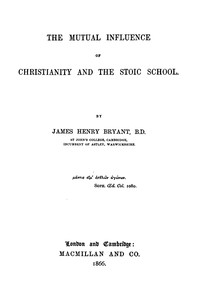
The mutual influence of Christianity and the Stoic school — A Closer Reading
(0 User reviews)
141
Project Gutenberg
2024
Not confirmed
Stoics; Christianity and other religions -- Greek; Civilization, Modern -- Classical influences
Readers of public-domain and historical texts
Project Gutenberg digital edition
en
Edition facts
Words
31,815
Reading time
139 min
Text sections
8
Before opening The mutual influence of Christianity and the Stoic school — A Closer Reading, the edition data offers a quick orientation: 31,815 words, 2 hr 19 min estimated reading time, and 8 detected text sections.
The text analysis averages about 23.1 words per sentence, while the detected sections provide another way to judge how the source is divided.
Project Gutenberg metadata also associates the work with “Stoics,” connecting these edition facts with the source record’s subject description.
Source:
Project Gutenberg record #73570
An 1865 Hulsean Dissertation examining parallels and mutual influence between Stoic philosophy and early Christian thought, focusing on Seneca's writings and the transition from pagan to Christian ethics.
Read the complete public-domain text at its original source.
Read on Project GutenbergJames Henry Bryant's 1865 Hulsean Dissertation, The Mutual Influence of Christianity and the Stoic School, approaches its subject through a comparative lens that is both historical and theological. The work, originally a Cambridge prize essay, examines how Stoic philosophy and Christianity interacted during the early centuries, with particular attention to the writings of Seneca. Bryant does not claim direct borrowing but traces affinities and tensions, noting that Seneca's language often echoes Christian concepts—such as an indwelling God and human moral weakness—while remaining distinct in its lack of a doctrine of redemption.
Seneca's Ambiguous Position
Bryant devotes considerable attention to Seneca, whom he describes as a figure caught between Stoic tradition and emerging Christian ideas. He quotes Gataker's characterization of Seneca as “home exterior, nec nomini Christiano favens”—a man outwardly unconnected to Christianity—yet argues that Seneca's writings show awareness of Jewish and Christian teachings. Bryant points to passages where Seneca speaks of God coming “into men” and of a “holy spirit” dwelling within, phrases that resemble New Testament language. However, he cautions that Seneca's understanding was incomplete: he was “ignorant of the glorious mystery of redemption” and did not mention pardon for past sin. This tension, Bryant suggests, reflects a mind in transition, struggling to reconcile old Stoic doctrines with new light.
Parallels and Limits in Moral Doctrine
Bryant identifies several points of convergence between Stoic and Christian ethics. He notes Seneca's view that “no mind is good without God” and that God sows seeds of virtue in human souls—a metaphor Bryant compares to the Parable of the Sower in Matthew 13. He also highlights Seneca's recognition of universal human sinfulness: “We have all sinned; some deeply, others more lightly.” Yet Bryant is careful to mark the limits of this parallel. Stoicism, he observes, held to the idea of man's unaided progress toward perfection, whereas Christianity emphasized divine grace. Seneca's admission that the indwelling deity was an “unknown God” (quoting Acts 17:23) underscores the gap between his philosophy and Christian revelation. Bryant's analysis thus balances recognition of affinity with insistence on fundamental difference.
The Dissertation's Structure and Method
Bryant organizes his argument in four chapters: an overview of Stoic philosophy, a comparison with Christianity, the influence of Christianity on Stoicism, and the influence of Stoicism on the Christian Church. The excerpts show him working closely with primary texts, especially Seneca's Epistles and De Clementia, and engaging with earlier scholars like Gataker. He is attentive to historical context, noting that Stoicism prepared the Roman mind for Christianity through its emphasis on divine providence and moral seriousness. At the same time, he acknowledges that the evidence for direct influence is often circumstantial, and he avoids claiming more than the texts warrant. His method is cautious, grounded in specific quotations and careful qualification.
Bryant's dissertation rewards readers interested in the intellectual cross-currents of late antiquity. His focus on Seneca as a transitional figure—neither Christian nor purely pagan—offers a nuanced case study in how philosophical and religious traditions interact. The work is best approached as a historical argument rather than a theological treatise, and its value lies in its close reading of primary sources and its refusal to overstate conclusions.
Something about tracing how Seneca’s letters overlap with early Christian patience reminds me of evenings spent re-reading the quiet logic in The Ritual Movement Three plain sermons preached at St. John the Evangelist's, Hammersmith — Themes and Context. Both books ask how outer forms settle into inner stillness—not as opposites, but as slow echoes. That older feeling returns, unhurried and half-formed.
There are no reviews for this eBook.
There are no comments for this eBook.
Reader reflection
How will you remember this book?
Save your reaction, strongest insight, and memorable passage.
Your progress
0
/
10
2
What was your overall reaction to the book?
3
Would you recommend this book to another reader?
4
What was the reading difficulty like?
5
Could you see yourself revisiting this book?
6
How clear did the writing feel?
7
How did the reading compare with what you expected?
8
Which element worked best for you?
9
What is the main idea you are taking away?
10