About 34 minutes
The Believer Not Ashamed of the Gospel — A Reader’s Guide
Theology
7,616 recorded words. 5 minutes difference from this book's estimate.
View Gutenberg source #52743
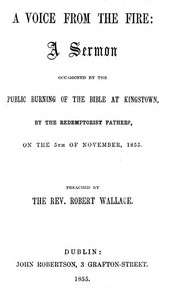
This digital edition of A voice from the fire — Inside the Classic is described by source-level measurements including 6,658 words, 29 min estimated reading time, and 1 detected text section.
The text analysis averages about 27.5 words per sentence, while the detected sections provide another way to judge how the source is divided.
Project Gutenberg metadata also associates the work with “Bible -- Sermons,” connecting these edition facts with the source record’s subject description.
Explore this collection
These alternatives are selected using recorded categories and estimated reading time.
About 34 minutes
Theology
7,616 recorded words. 5 minutes difference from this book's estimate.
View Gutenberg source #52743About 34 minutes
Theology
7,720 recorded words. 5 minutes difference from this book's estimate.
View Gutenberg source #64496About 24 minutes
Theology
5,385 recorded words. 5 minutes difference from this book's estimate.
View Gutenberg source #64735Search stored excerpts and compare books → Choose by your preferences →
Choices use stored catalog measurements. Estimates vary with reading speed. A shared category is a catalog label, not a claim that two books have the same argument or literary quality.
Search reads excerpt text stored with this catalog and links to its associated Gutenberg record. The connection is stored in the site database; this tool does not recheck that every excerpt is word-for-word identical to that external record. Excerpt search does not cover every chapter and does not verify historical publication dates.
Catalog snapshot checked: 2026-09-25. Coverage: 90 public books, 90 available source excerpts.
Read the complete public-domain text at its original source.
Read on Project GutenbergThe sermon opens with a precise historical trigger: the public burning of a Bible at Kingstown on 5 November 1855 by Redemptorist Fathers. Wallace immediately anchors his response in a recovered fragment—the Deuteronomy passage that becomes his epigraph and structural spine. The title itself, A Voice from the Fire, echoes the biblical voice from Horeb while reframing it as a contemporary rebuke. The preacher’s voice moves from measured theological exposition—arguing for the necessity of a written revelation—to a more urgent, hortatory register as he addresses different audiences. The pace accelerates notably in the final sections, where short, imperative sentences and rhetorical questions replace the earlier periodic style.
Wallace does not merely cite Deuteronomy 4:12–17; he presents it as a physical fragment “taken out of the Fire, and given to the Preacher upon the spot.” This framing transforms the biblical text into a material witness. The epigraph’s warning against making “a graven image” directly parallels the act of Bible-burning, which Wallace treats as an iconoclastic inversion. The sermon’s structure repeatedly returns to this passage, creating a refrain that binds the historical event to scriptural precedent. The phrase “ye heard the voice of the words, but saw no similitude” becomes a recurring touchstone, emphasizing the primacy of the spoken word over visual representation.
The sermon’s opening paragraphs employ a formal, almost academic tone: “It is not our intention at this time to elaborate arguments for the necessity of a divine revelation.” Wallace builds a case through historical examples—Greece and Rome—and logical deduction. But as he turns to address Protestants directly, the syntax tightens. Sentences become shorter, more imperative: “There must be no blinking the question or softening it down.” The pace quickens with a series of parallel clauses beginning “The love of country—the love of learning—of liberty, religion, and of God.” This shift from exposition to exhortation mirrors the sermon’s movement from doctrine to application, and from the past event to present duty.
Wallace organizes his address by audience: first the adversaries, then Protestants. This division is not merely rhetorical but reflects a pastoral strategy. To the adversaries he offers no direct speech; instead, he frames their act as a crime requiring clear naming. To Protestants he issues a series of duties: appreciate the act’s real character, avoid transferring hatred to persons, and unite across denominations. The final appeal to “justification by faith alone” and the repeated “he that hath the Son” formula creates a liturgical cadence. The sermon ends with a prophetic cry—“BABYLON THE GREAT IS FALLEN!”—that shifts from reasoned argument to apocalyptic declaration, completing the arc from historical report to eschatological warning.
Readers will notice how Wallace’s voice modulates between the deliberative and the urgent, often within a single paragraph. The recovered Bible fragment functions as both a literal object and a rhetorical device, linking the 1855 burning to the Sinai theophany. The sermon rewards attention to its structural turns: the moment when argument gives way to exhortation, and when the preacher steps from commentator to prophet. These shifts in pace and register are the sermon’s primary literary engine.
That old sermon’s urgency stayed with me—how a public burning could make a pastor’s voice crack with care. It made me think of Does civilization need religion? — Story, Setting & Ideas, which quietly asks what we hold when the flames die down. A softer echo, same embers.
Answer a few questions and save a private reflection on this device.