1

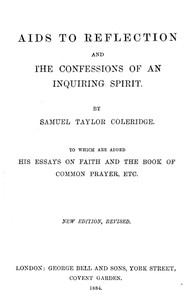
Aids to Reflection; and, The Confessions of an Inquiring Spirit — Inside the Classic
(0 User reviews)
351
Project Gutenberg
2014
Not confirmed
Conduct of life; Bible -- Inspiration; Aphorisms and apothegms; Faith; Bible -- History; Coleridge, Samuel Taylor, 1772-1834 -- Religion; Religion -- Quotations, maxims, etc.
Readers of public-domain and historical texts
Project Gutenberg digital edition
en
Edition facts
Words
163,853
Reading time
713 min
Text sections
19
This digital edition of Aids to Reflection; and, The Confessions of an Inquiring Spirit — Inside the Classic is described by source-level measurements including 163,853 words, 11 hr 53 min estimated reading time, and 19 detected text sections.
The text analysis averages about 27.4 words per sentence, while the detected sections provide another way to judge how the source is divided.
Project Gutenberg metadata also associates the work with “Conduct of life,” connecting these edition facts with the source record’s subject description.
Source:
Project Gutenberg record #44795
Coleridge's Aids to Reflection and Confessions of an Inquiring Spirit, with James Marsh's preliminary essay, explores the nature of faith, original sin, and redemption through aphorisms and commentary, drawing on Jeremy Taylor and others.
Read the complete public-domain text at its original source.
Read on Project GutenbergThis volume combines two of Coleridge's later theological works, Aids to Reflection (1825) and Confessions of an Inquiring Spirit (posthumous), along with an essay on faith and notes on the Book of Common Prayer. The edition includes a substantial preliminary essay by American editor James Marsh, who helped introduce Coleridge's thought to a transatlantic audience. The text is structured around aphorisms—short, pointed statements—each followed by Coleridge's expansive commentary. The catalog subjects list 'Conduct of life,' 'Bible—Inspiration,' and 'Faith,' but the excerpts reveal a more specific focus: Coleridge engages directly with Jeremy Taylor's arguments on original sin, redefining sin not as inherited guilt but as 'originant, underived from without.'
Aphorism as Method
The book's organizing principle is the aphorism, a form Coleridge uses to provoke reflection rather than to assert dogma. The opening 'Introductory Aphorisms' set the tone, but the most revealing example is Aphorism X, which quotes Jeremy Taylor at length. Coleridge does not simply refute Taylor; he selects him as 'the ablest and most formidable antagonist' of the doctrine of original sin. By framing the discussion around a chosen opponent, Coleridge turns the aphorism into a dialectical tool. The commentary that follows is not a line-by-line rebuttal but a redefinition: Coleridge distinguishes 'Original Sin' from 'Sin inflicted' or 'implanted,' insisting on sin as an act of the will. This method—juxtaposing a quoted aphorism with his own philosophical expansion—recurs throughout the work, making the reader an active participant in the reasoning.
The Problem of Evil and Human Nature
Coleridge explicitly sets aside the question of the origin of evil as a 'barren controversy.' Instead, he focuses on the evil that 'most concerns himself, and of which he may find the origin.' This shift from cosmic to personal is evident in the excerpt from Taylor, which describes Adam's fall as bringing 'evil into his supernatural endowments' and leaving humanity with 'a sickly body, and a passionate and ignorant soul.' Coleridge's commentary builds on this image, emphasizing that sin is not a passive link in a chain of causation but an active, underived principle. The language is vivid: sin is a 'febrifuge against aguish scruples and horrors, the hectic of the soul.' The catalog subject 'Conduct of life' thus takes on a specific meaning—not moral advice, but an inward examination of the will's relation to evil.
Marsh's Editorial Role
James Marsh's preliminary essay, included in this edition, is more than a simple introduction. Marsh, a Vermont theologian, had previously published an edition of Aids to Reflection in the United States (1829), and his essay helped shape American reception of Coleridge's religious thought. The note to this edition states that Marsh's essay is printed from his own second edition (1840). Marsh's presence as 'Contributor' in the catalog is thus significant: he is not merely a proofreader but an interpreter who frames Coleridge's work for a new audience. The excerpts do not include Marsh's essay, but its inclusion alongside Coleridge's texts suggests a dialogue between British and American theological currents. Readers should note that the volume also contains Coleridge's 'Essay on Faith' and 'Notes on the Book of Common Prayer,' appended as possible parts of a contemplated supplementary volume.
Readers approaching this edition should expect a demanding, layered text that rewards careful attention to Coleridge's distinctions—between reason and understanding, between sin as act and sin as condition. The aphoristic structure invites slow reading, and the frequent footnotes (some extending over pages) require patience. Marsh's essay provides a useful entry point, but Coleridge's own voice, with its characteristic blend of philosophical rigor and poetic metaphor, remains central.
The rain kept me indoors with Coleridge’s Aids to Reflection, his aphorisms about original sin settling like damp leaves on the windowpane. Later, pages blurred into a quieter wondering about what faith actually rests upon, and I found myself reaching for Chesterton’s The Everlasting Man almost without deciding to. It felt less like a leap than a turn. The Everlasting Man — Context and Discussion lingered beside Coleridge’s fragments all afternoon, two voices agreeing in the gloom.
There are no reviews for this eBook.
There are no comments for this eBook.
Reader reflection
What did you think of this book?
Answer a few questions and save a private reflection on this device.
Your progress
0
/
10
2
How much did you enjoy the reading experience?
3
Would you recommend this book to another reader?
4
Did the language feel accessible?
5
Would you read this book again?
6
Would you start a conversation about this book?
7
How clear did the writing feel?
8
Did any part of the book stay with you emotionally?
9
What is the main idea you are taking away?
10