1

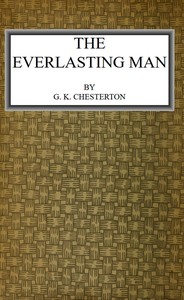
The Everlasting Man — Context and Discussion
(0 User reviews)
143
Project Gutenberg
2021
Not confirmed
Religion; Christianity and other religions; Catholic Church -- Apologetic works
Readers of public-domain and historical texts
Project Gutenberg digital edition
en
Edition facts
Words
110,858
Reading time
482 min
Text sections
9
For The Everlasting Man — Context and Discussion, the stored edition analysis reports 110,858 words, 8 hr 2 min estimated reading time, and 9 detected text sections.
The text analysis averages about 25.4 words per sentence, while the detected sections provide another way to judge how the source is divided.
Project Gutenberg metadata also associates the work with “Religion,” connecting these edition facts with the source record’s subject description.
Source:
Project Gutenberg record #65688
Chesterton contrasts pagan domestic religion with Roman political revolt, arguing that Christianity is historically unique, not a myth among myths, in this 1925 theological work.
Read the complete public-domain text at its original source.
Read on Project GutenbergChesterton opens The Everlasting Man by distinguishing his approach as historical rather than theological, though he acknowledges writing as a Catholic. He frames the book as a response to those who place Christ among similar myths, calling that formula “stale” and contradicted by “a very striking fact.” The preface sets up a journey: not a straight path home, but a circuit around the world to return to the starting point—a metaphor Chesterton borrows from his own unwritten romance about the White Horses of Wessex.
The excerpts show Chesterton’s method: he dwells on concrete, domestic details of ancient religion—gods of roofs, gateposts, doors, even drains—to argue that paganism was a “fireside tale.” He then pivots to the paradox of Rome, a state built on barricades, where domestic piety fueled political revolt. This tension between the homely and the revolutionary is the engine of his argument.
Household Gods and Political Revolt
Chesterton devotes considerable space to the religion of the Roman household, describing “divinities swarming about the house like flies” and “clustering like bats about the pillars.” He emphasizes that these gods were not abstract forces but personifications of human-transformed nature: the god of corn, not grass; of cattle, not wild beasts. This cult, he says, was literally a culture—agriculture.
Yet he immediately undercuts any notion of Roman stability. Rome, he insists, was “the very reverse” of order; its history resembles “modern Paris” in its barricades. The state that imposed peace on the world was never at peace internally. Chesterton links these two facts: only those for whom the family is sacred can criticize the state, appealing to “something more holy than the gods of the city.” He cites the Irish and French as modern examples of this paradox.
The War of Gods and Demons
In a chapter titled “The War of the Gods and Demons,” Chesterton turns to Carthage—the “New Town” on the opposite coast—as the antagonist that forced Rome to transform. He does not narrate the Punic Wars in detail but uses the confrontation to illustrate his broader thesis: that paganism contained both domestic piety and uglier elements, such as the Arician rite of “the priest slaying the slayer.” These were “always potential in paganism,” he notes, but not its peculiar character.
The war metaphor extends beyond military conflict. Chesterton suggests that the clash between Rome and Carthage was also a clash of religious visions—one rooted in hearth and field, the other in something more alien. He leaves the reader to infer that this struggle prefigures the later confrontation between paganism and Christianity, which he addresses in Part II.
The Amateur Historian’s Method
Chesterton is candid about his limitations. In the preface he writes, “I make no claim to learning; and have to depend for some things, as has rather become the fashion, on those who are more learned.” He praises H. G. Wells for asserting “the reasonable right of the amateur to do what he can with the facts which the specialists provide.” This self-deprecation is strategic: it frees him to make broad, provocative claims without being pinned down by scholarly apparatus.
The excerpts reveal a writer who thinks in images and paradoxes. He describes the domestic gods as “great, clumsy, wooden images, more featureless than the figure-head which Quilp battered with the poker”—a reference to Dickens. His prose is dense with simile and allusion, but his argument is linear: he moves from the particular (a god of drains) to the general (the nature of pagan religion) to the historical (Rome’s internal revolutions).
Chesterton’s The Everlasting Man rewards readers who attend to its concrete details—the gods of gateposts, the barricades of Rome, the unwritten romance of the White Horse. His method is to start small and build outward, using paradox to unsettle conventional categories. The book is not a systematic theology but a series of provocations, each anchored in a vivid image. Readers will find it most useful to follow Chesterton’s own advice: look for the inside of history, the household gods, before judging the larger claims.
When Chesterton speaks of that stubborn, singular strangeness in Christianity, I find myself thinking of the old scholastic habit of asking why something moves us at all. It’s a quiet kinship across the centuries. Reading the Summa Theologica, Part I-II (Pars Prima Secundae) From the Complete American Edition — Themes and Context brings back that same unhurried wonder, like finding a familiar lamp still burning in a room we’d almost forgotten.
There are no reviews for this eBook.
There are no comments for this eBook.
Reader reflection
What did you think of this book?
Answer a few questions and save a private reflection on this device.
Your progress
0
/
10
2
Was reading this book enjoyable?
3
Would you recommend this book to another reader?
4
How easy was the book to follow?
5
Did the story or argument move comfortably?
6
Would you like to discuss this book with someone?
7
Did anything about the book feel genuinely new?
8
Did the book meet your expectations?
9
What is the main idea you are taking away?
10