1

Physico-theology — Story, Setting & Ideas
(0 User reviews)
1229
Project Gutenberg
2025
Not confirmed
Natural theology -- Early works to 1800; Sermons, English -- 18th century; God -- Attributes -- Early works to 1800; Natural history -- Pre-Linnean works
Readers of public-domain and historical texts
Project Gutenberg digital edition
en
Edition facts
Words
168,633
Reading time
734 min
Text sections
84
Before opening Physico-theology — Story, Setting & Ideas, the edition data offers a quick orientation: 168,633 words, 12 hr 14 min estimated reading time, and 84 detected text sections.
The text analysis averages about 27.0 words per sentence, while the detected sections provide another way to judge how the source is divided.
Project Gutenberg metadata also associates the work with “Natural theology -- Early works to 1800,” connecting these edition facts with the source record’s subject description.
Source:
Project Gutenberg record #75254
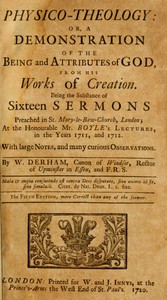
In this 1720 edition of his Boyle Lectures, Derham examines animal anatomy, instinct, and parental care as evidence of divine design, using detailed observations of opossum tails, parrot feeding, and bird behavior.
Read the complete public-domain text at its original source.
Read on Project GutenbergDerham opens his dedication by describing the work as 'the diverting Exercises of my Leisure Hours, rather than more serious Theological Studies,' a remark that belies the systematic rigor of the sixteen sermons that follow. The book, subtitled 'A Demonstration of the Being and Attributes of God, from His Works of Creation,' proceeds by accumulating anatomical and behavioral evidence from the natural world. Derham, a Fellow of the Royal Society, draws on contemporary naturalists such as Dr. Tyson and John Ray, and frequently cites classical authorities like Cicero and Pliny. The resulting text is a hybrid: part sermon, part natural history treatise, and part philosophical argument.
Mechanical Design in Animal Anatomy
Derham devotes considerable attention to the physical structures of animals, treating them as instances of 'Nature’s Mechanism.' In a note on the opossum, he quotes Dr. Tyson’s description of the 'Spines, or Hooks' on the underside of the tail vertebrae, which allow the animal to hang from boughs with 'but little labour of the Muscles required.' Derham marvels that 'nothing, I think, could be more advantagiously contrived' for this purpose. Similarly, he notes the opossum's abdominal pouch, supported by 'two Bones (not to be met with in any other Skeleton) and four Pair of Muscles.' These observations are not merely descriptive; they serve as evidence for a designed universe. Derham’s method is to isolate a functional problem—climbing, carrying young—and then show how the animal’s anatomy solves it with apparent foresight. The tone is one of wonder at the ingenuity of the Creator, but the argument is grounded in specific, often technical, anatomical details.
Instinct and Parental Care as Providential Signs
Derham extends his argument from anatomy to behavior, particularly the instinctual care of offspring. He cites Cicero’s observation that birds 'quietum requirunt ad pariendum locum' and build nests 'quam possunt mollissimè substernunt' to protect their eggs. But Derham goes further, collecting examples of what he calls 'conjugal Στοργὴ'—natural affection. He recounts how aged female parrots would not eat unless the male first softened the food in his beak, 'quasi coctum.' He also notes that even timid animals, such as hens and partridges, will expose themselves to danger for their young: partridges 'drop frequently down' to distract predators. These behaviors, Derham implies, cannot be explained by mere mechanism; they point to a benevolent designer who instilled such instincts. The argument here is less about physical structure and more about the apparent purposefulness of animal actions, a theme that recurs throughout the lectures.
Classical and Contemporary Sources in Tension
Derham’s citations reveal a tension between ancient authority and modern empirical observation. He frequently invokes Cicero’s De Natura Deorum and Pliny’s Natural History, alongside recent works like Dr. Tyson’s anatomy of the opossum (published in the Philosophical Transactions) and John Ray’s Synopsis Methodica Avium. For instance, he follows a quotation from Cicero on bird nesting with a note from Pliny on rats supporting their aged parents, then adds a modern account of the 'little green Æthiopian Parrot' from Clusius via Ray. The juxtaposition is not merely decorative; it suggests that ancient wisdom and modern science converge on the same conclusion. Yet Derham does not always reconcile them smoothly. The classical authors provide moral and rhetorical weight, while the contemporary naturalists supply the precise anatomical data that Derham values as a Fellow of the Royal Society. This dual allegiance shapes the book’s argumentative style.
Readers approaching Physico-theology should attend to the interplay between its two registers: the homiletic frame of the Boyle Lectures and the empirical detail drawn from natural history. Derham’s notes, often longer than the sermon text, contain the most striking observations. The book rewards those who read with an eye for the specific—the hook-like spines of the opossum’s tail, the feeding behavior of parrots—rather than for the overarching theological argument alone.
I found myself thinking of Derham’s careful opossums and their stubborn tails, how he watched them with such patient awe. It reminded me, strangely, of Coleridge’s quieter reverence—that same unhurried attention, but turned inward. Both men saw a kind of order, one in tendons, the other in the tangled workings of belief itself. Aids to Reflection; and, The Confessions of an Inquiring Spirit — Inside the Classic felt like a different shade of that same old wonder.
There are no reviews for this eBook.
There are no comments for this eBook.
Reader reflection
What did you think of this book?
Answer a few questions and save a private reflection on this device.
Your progress
0
/
10
2
Was reading this book enjoyable?
3
How likely are you to recommend this book?
4
What was the reading difficulty like?
5
Which part made the strongest impression?
6
How strong was your personal connection to the text?
7
Did the book offer a fresh perspective?
8
Could you apply anything you learned?
9
What changed or sharpened your thinking?
10