
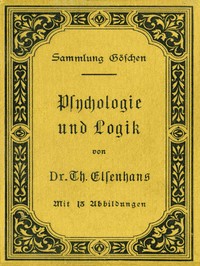
Psychologie und Logik: zur Einführung in die Philosophie by Theodor Elsenhans
Read "Psychologie und Logik: zur Einführung in die Philosophie by Theodor Elsenhans" Online
This book is available in the public domain. Start reading the digital edition below.
START READING FULL BOOKBook Preview
A short preview of the book’s content is shown below to give you an idea of its style and themes.
First published in 1913, Theodor Elsenhans's book isn't a story in the traditional sense. Think of it as an intellectual blueprint. Elsenhans sets out to explore the fundamental connection between two pillars of human understanding: psychology (the study of how our minds actually work) and logic (the study of correct reasoning). He argues that you can't really do philosophy properly without understanding both. The 'plot' is his journey to show how our inner mental life—our perceptions, judgments, and feelings—relates to the external, objective rules of logic. He's trying to find common ground, asking if the structures of our thought have a logical backbone we can rely on.
Why You Should Read It
This book feels like a time capsule from a pivotal moment in thought. Reading it, you get a front-row seat to the early 20th-century struggle to define what philosophy even is. Is it a science of the mind, or a system of abstract rules? Elsenhans doesn't give easy answers, and that's what makes it compelling. You can almost feel his urgency to create a stable foundation for knowledge before the world gets even more complicated. It’s less about memorizing theories and more about witnessing a thinker grapple with huge, enduring questions.
Final Verdict
This is a niche pick, but a rewarding one. It's perfect for readers curious about the history of ideas, or anyone who enjoys seeing how big philosophical debates started. If you've ever taken a psychology *and* a philosophy class and wondered how they fit together, Elsenhans gives you the 1913 answer. It's not a light beach read, but for a short book, it packs a serious punch and offers a fascinating glimpse into a forgotten corner of intellectual history.
Legal analysis indicates this work is in the public domain. It is now common property for all to enjoy.
Melissa Moore
1 year agoI stumbled upon this title and the arguments are well-supported by credible references. Truly inspiring.
Aiden Lewis
7 months agoJust what I was looking for.
Richard Gonzalez
1 year agoI started reading out of curiosity and it provides a comprehensive overview perfect for everyone. Worth every second.
Brian Flores
6 months agoText is crisp, making it easy to focus.



George Anderson
1 year agoAs someone who reads a lot, the flow of the text seems very fluid. Worth every second.